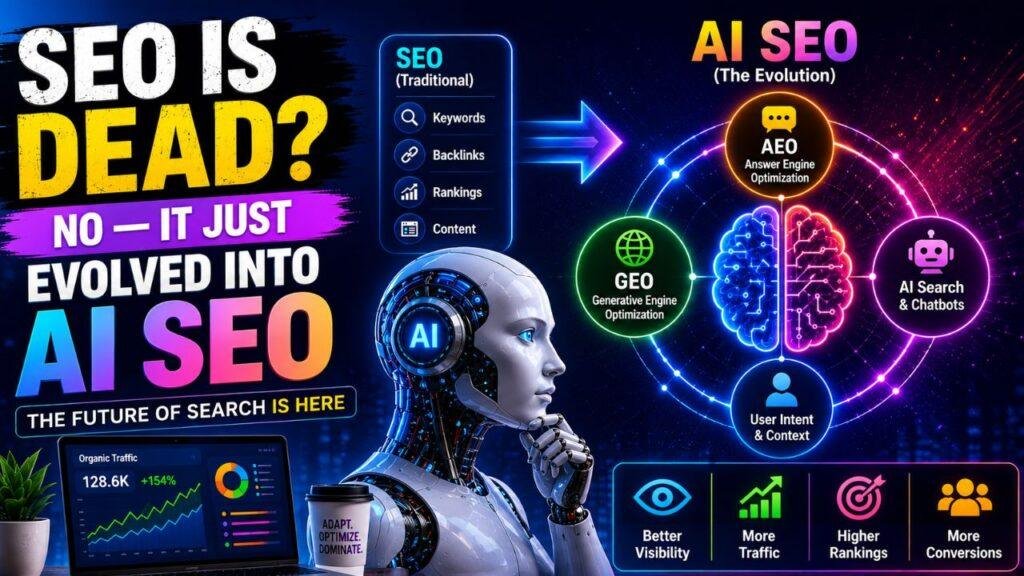
For years, people have been saying that SEO is dead. Every major algorithm update, every shift in user behavior, and now the rise of artificial intelligence have fueled this debate even more.
However, the truth is simple: SEO is not dead—it has evolved.
Today, we are no longer just optimizing for search engines like Google. Instead, we are entering a new era where optimization extends to AI-driven platforms like ChatGPT, Perplexity AI, and Microsoft Copilot.
This transformation has given birth to a new concept: AI SEO.
In this guide, you will learn what AI SEO is, why traditional SEO is changing, and how you can adapt your strategy to stay ahead in 2026 and beyond.
What Does “SEO is Dead” Really Mean?
When people say SEO is dead, they usually mean that old SEO tactics no longer work.
A decade ago, ranking was easier. You could:
- Stuff keywords into content
- Build spammy backlinks
- Publish low-quality articles
And still rank on the first page.
However, modern search engines have become much smarter. With advancements in machine learning, natural language processing, and user intent analysis, platforms like Google now prioritize:
- High-quality content
- User experience
- Search intent
- Authority and trust
So, SEO isn’t dead—it’s just more intelligent and user-focused.
The Rise of AI SEO
AI SEO is the next evolution of search optimization.
Instead of focusing only on search engine rankings, AI SEO ensures your content is discoverable across:
- Search engines
- AI chatbots
- Voice assistants
- Generative search platforms
For example, users are now asking questions directly to tools like ChatGPT instead of searching on traditional search engines.
This means your content must be optimized not just for keywords, but also for answers.
From SEO to AEO and GEO
To understand AI SEO better, you need to know two important concepts:
1. AEO (Answer Engine Optimization)
AEO focuses on optimizing your content to provide direct answers to user queries.
AI platforms prioritize content that is:
- Clear and structured
- Fact-based
- Easy to understand
2. GEO (Generative Engine Optimization)
GEO is about optimizing your content for AI-generated responses.
When someone asks a question on ChatGPT or Perplexity AI, these platforms generate answers using high-quality sources.
Your goal is to become one of those trusted sources.
Why AI SEO Matters More Than Ever
The way people search is changing rapidly.
Instead of typing:
“best SEO expert in Bangladesh”
Users now ask:
“Who is the best SEO expert for e-commerce growth?”
This shift means:
- Queries are becoming conversational
- Search intent is more specific
- Users expect instant answers
As a result, AI SEO helps you:
- Increase visibility across multiple platforms
- Build authority in your niche
- Drive high-quality traffic
- Stay ahead of competitors
Key Differences Between Traditional SEO and AI SEO
Traditional SEO:
Focus on keywords
Optimize for search engines
Rank on SERPs
AI SEO:
Focus on user intent and context
Optimize for AI platforms
Appear in generated answers
In short, traditional SEO is about ranking, while AI SEO is about visibility everywhere.
How to Optimize for AI SEO (Step-by-Step)
To succeed in this new era, you need to update your strategy.
1. Focus on Search Intent
Stop writing for keywords only. Instead, understand:
- What users are looking for
- Why are they searching
- What problem do they want to solve?
Your content should directly address those needs.
2. Create High-Quality, In-Depth Content
AI platforms prefer content that is:
- Comprehensive
- Accurate
- Well-structured
Use:
- Headings and subheadings
- Short paragraphs
- Bullet points
This improves readability and AI understanding.
3. Use Conversational Language
Since AI tools like ChatGPT process natural language, your content should feel human and conversational.
Write like you’re explaining something to a real person.
4. Optimize for Featured Snippets
Featured snippets are often used by AI systems.
To increase your chances:
- Answer questions directly
- Use clear definitions
- Add FAQ sections
5. Build Topical Authority
Instead of writing random blogs, focus on a specific niche.
For example:
- Local SEO
- E-commerce SEO
- Technical SEO
Create multiple related articles to establish authority.
6. Improve Technical SEO
Even in AI SEO, technical factors still matter.
Ensure your website has:
- Fast loading speed
- Mobile-friendly design
- Clean site structure
- Proper schema markup
7. Leverage AI Tools Smartly
Use AI tools to:
- Generate ideas
- Analyze competitors
- Improve content quality
But avoid over-reliance. Human creativity and expertise are still essential.
Common Mistakes to Avoid in AI SEO
Many people misunderstand AI SEO and make critical mistakes:
- Writing generic, low-value content
- Ignoring user intent
- Overusing AI without editing
- Not updating old content
- Focusing only on Google rankings
To succeed, you need a balanced approach.
The Future of SEO: What to Expect
SEO will continue evolving as AI becomes more advanced.
In the near future, we can expect:
- More personalized search results
- Increased use of voice search
- Greater reliance on AI-generated answers
- Less emphasis on traditional rankings
This means one thing: adaptation is key.
Final Thoughts
So, is SEO dead?
Absolutely not.
It has simply transformed into something more powerful—AI SEO.
If you continue using outdated strategies, you will struggle. However, if you embrace change and optimize for both search engines and AI platforms, you will stay ahead of the competition.
The future belongs to those who understand this shift early and take action.
FAQs
Is SEO still relevant in 2026?
Yes, SEO is still highly relevant, but it has evolved into AI SEO, focusing on user intent and AI platforms.
What is AI SEO?
AI SEO is the process of optimizing content for search engines and AI-driven platforms like ChatGPT and Perplexity.
How can I rank on AI platforms?
Focus on high-quality content, clear answers, and strong topical authority.